Investing with Komplete Investments

At Komplete Investments, we approach capital management with an emphasis on context, judgment, and responsibility. Markets are influenced by shifting economic conditions, policy decisions, and long-term structural forces, and meaningful outcomes are rarely the result of isolated actions. The insights shared here are intended to support thoughtful consideration rather than immediate response. Each post offers perspective on how broader market dynamics and strategic principles intersect over time.

These articles are provided as educational resources designed to encourage informed evaluation and constructive discussion. They are not prescriptive in nature, but meant to complement disciplined oversight and individual decision-making. We recognize that effective capital management requires alignment with personal objectives, risk considerations, and long-term priorities. By engaging with this content as part of a broader framework, readers can better assess how insight, structure, and consistency contribute to sustainable outcomes across market cycles.

Now Show Japan - A Wealth of Common Sense

Now Show Japan – A Wealth of Common Sense


As a torchbearer for long-term investing I’ve heard the phrase now show Japan about a million times.

Those three words were one of the biggest inspirations for me writing Risk & Reward.

How could you possibly invest for the long-run in stocks when a situation like Japan exists?

It’s a fair question.

Japan is the subject that has come up the most times in all of the interviews I’ve done for the book as well.

Are we in a bubble just like Japan was?

Isn’t Japan the exception to the rule of long-term investing?

Could that happen here too?

I find the topic of Japan’s boom and bust to be endlessly fascinating. Surprisingly, there aren’t a ton of books out there on what I feel is the biggest financial asset bubble in history.

The least I could do is write two chapters on the topic to give you a better sense of what happened.

My initial pitch to Harriman House on the book was giving every topic it’s own yin and yang (risk and reward) chapters. One chapter would cover a historical risk in the markets to show how bad things can get. The follow-up chapter would provide some context about those risks and offer different ways to protect yourself.1

The two chapters on Japan were my favorite to write.

Let’s look at some data from the book to now show Japan.

The boom times were beyond silly:

So were the valuations:
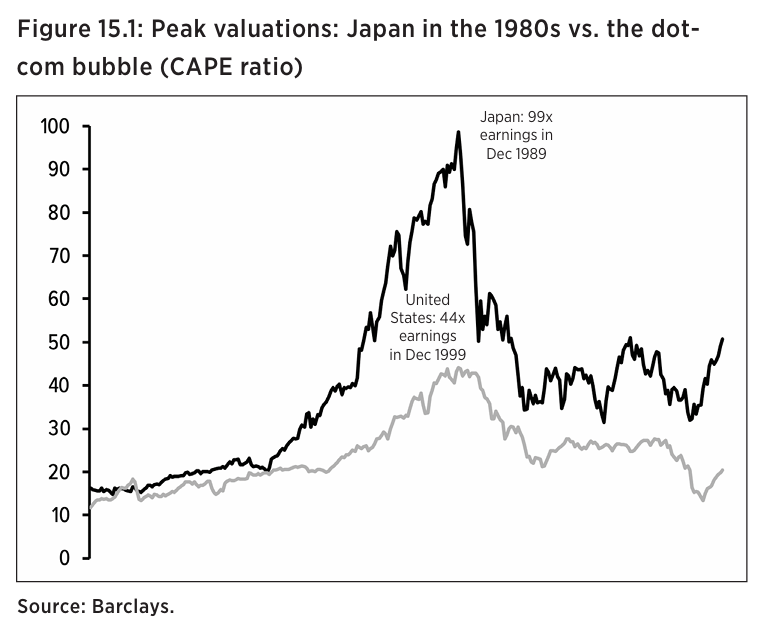
This next chart is very important:
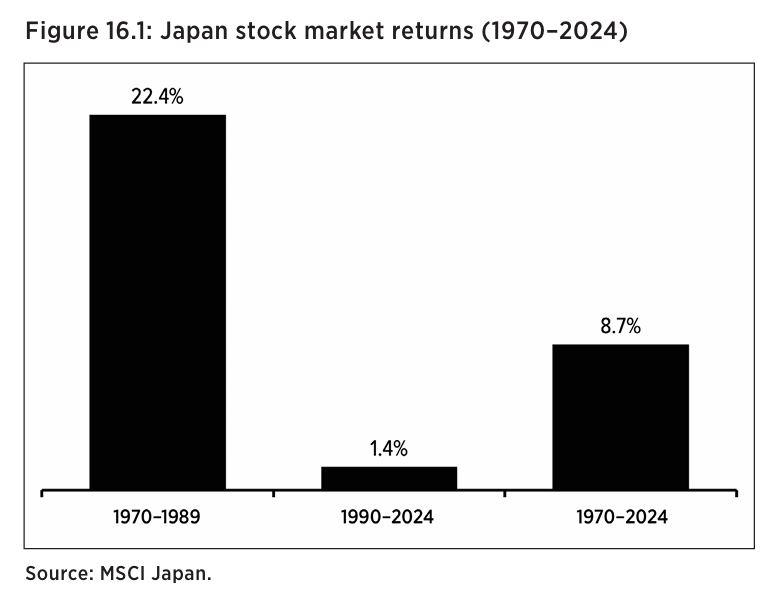
Long-term investing did work in Japan!

The problem is the returns were so compressed into the 1970s and 1980s that the performance in the subsequent decades had to be downright terrible to even things out.

There’s a lot more context, stories, data and explanations in the book.

Buy yourself a copy if you would like to learn more about the biggest bubble in history:
Further Reading:
The Case For International Diversification

1I even toyed with the idea of titling the book Now Show Japan. That would have been a little too inside baseball.

This content, which contains security-related opinions and/or information, is provided for informational purposes only and should not be relied upon in any manner as professional advice, or an endorsement of any practices, products or services. There can be no guarantees or assurances that the views expressed here will be applicable for any particular facts or circumstances, and should not be relied upon in any manner. You should consult your own advisers as to legal, business, tax, and other related matters concerning any investment.

The commentary in this “post” (including any related blog, podcasts, videos, and social media) reflects the personal opinions, viewpoints, and analyses of the Ritholtz Wealth Management employees providing such comments, and should not be regarded the views of Ritholtz Wealth Management LLC. or its respective affiliates or as a description of advisory services provided by Ritholtz Wealth Management or performance returns of any Ritholtz Wealth Management Investments client.

References to any securities or digital assets, or performance data, are for illustrative purposes only and do not constitute an investment recommendation or offer to provide investment advisory services. Charts and graphs provided within are for informational purposes solely and should not be relied upon when making any investment decision. Past performance is not indicative of future results. The content speaks only as of the date indicated. Any projections, estimates, forecasts, targets, prospects, and/or opinions expressed in these materials are subject to change without notice and may differ or be contrary to opinions expressed by others.

The Compound Media, Inc., an affiliate of Ritholtz Wealth Management, receives payment from various entities for advertisements in affiliated podcasts, blogs and emails. Inclusion of such advertisements does not constitute or imply endorsement, sponsorship or recommendation thereof, or any affiliation therewith, by the Content Creator or by Ritholtz Wealth Management or any of its employees. Investments in securities involve the risk of loss. For additional advertisement disclaimers see here: https://www.ritholtzwealth.com/advertising-disclaimers

Please see disclosures here.


Source link

Expand Energy: Increases Expected Merger Synergies By $200 Million Per Year
  • 10 Friday AM Reads – The Big Picture

    My end-of-week morning reads: • Power Bill Divide: Soaring prices at some of America’s Biggest Utilities are fueling new scrutiny of the investor-owned model.  (Bloomberg) • What the Midterms Mean for Your Stock Portfolio: Midterm elections can move headlines. History says they shouldn’t move your portfolio. (Kiplinger) see also How governments spend money Charting the…

  • Animal Spirits: Are Higher Rates Worse Than ZIRP?

    Today’s Animal Spirits is brought to you by ProShares and Janus Henderson: On today’s show, we discuss: Listen here: Charts:   Tweets/BlueSky: One of the main reasons so many breadth indicators are off the charts is because the concentration in the index is like nothing we’ve ever experienced. The top 5 stocks in the S&P…

  • Transcript: Maria Vassalou, Head of the Pictet Research Institute

         The transcript from this week’s MiB, Maria Vassalou, Head of the Pictet Research Institute, is below. You can stream and download our full conversation, including any podcast extras, on Apple Podcasts, Spotify, YouTube (video), YouTube (audio), and Bloomberg. All of our earlier podcasts on your favorite pod hosts can be found here.…

  • Talk Your Book: Will AI Debt Cause a Recession?

    Today’s Talk Your Book is brought to you by JP Morgan: On today’s show, we discuss: JSOSX as a benchmark free fund, and the additional flexibility as a result Why avoiding duration risk has been the right call for the last five years How tight high yield spreads mask trouble showing in credit markets Why…