My mid-week morning reads:
• The Diesel Weapon: Why a rather unglamorous fuel is suddenly at the centre of a transatlantic power struggle, and why this matters for all of us (Material World)
• 250K per year is plenty of income: If you don’t feel rich here, you probably never will: Twitter of course hates this conversation because half that website is comprised of people terrible with money, or who actively trade (gamble) crypto/equities etc, or enjoy private taxis for their burritos (Uber eats). (Hot Takes) but see Even High Earners Are Living Paycheck to Paycheck: Why $300,000 Isn’t Enough Anymore: Amid worsening signals of retirement readiness, Goldman Sachs sees an opportunity for employers to provide financial guidance and support. (Barron’s)
• The Surge in Rates Is Blowing Up Commercial Real-Estate Deals: Buyers who signed contracts when financing was cheaper are now demanding price cuts or walking away. Special servicing on CMBS loans hit 11.42% in August, the highest since February 2013. (Wall Street Journal)
• When the financial system becomes searchable: Financial crises rarely begin with one self-contained weakness. They emerge when vulnerabilities connect: leverage meets a margin call; a margin call meets an illiquid market; falling prices meet common collateral; and a funding concern becomes a run. Before the event, each link may sit in a different spreadsheet, institution or jurisdiction. Afterwards, the route through them can look obvious. This post explores a possibility raised by advances in artificial intelligence (AI): that the financial system could become searchable, making more of those routes visible beforehand. (Bank Underground)
• The end of short-form content. I’m calling it: TikTok, Instagram, and Twitter are not going away, but their times as genuine social media platforms are behind them. It’s time to go long. (Embedded)
• Ce n’est pas la France qui quitte l’euro, c’est l’euro qui quitte la France: The move in French-German 2 year bond spreads today is reminiscent of the euro crisis. The ECB needs to step in. But its circuit-breaker could break the French government. (Half Macro Half Climate)
• The dawn of the age of the exoskeleton: The devices continue to show noticeable benefits for users in various real-world tasks. Ildar Farkhatdinov: from Seattle Mountain Rescue teams to warehouse workers, powered exoskeletons are leaving the lab and showing measurable gains in real-world tasks. (The Conversation)
• Russia’s new drive to crush Ukraine: Since July, Russian strikes have closed the Black Sea to shipping, stranding a bumper harvest in Ukrainian silos and pounding Odesa’s and Kyiv’s power grids. Ukraine’s shortage of Patriot interceptors is the binding constraint. Moscow’s relentless offensive on cities and ports has stalled the country’s Black Sea grain exports, severing an economic lifeline. (Financial Times) see also War Is Forcing the World to Reckon With Geography’s Power: Patricia Cohen: we thought money, goods and information had beaten distance. Then one blocked Persian Gulf shipping route pushed up energy prices and interest rates, disrupted factories and threatened harvests worldwide. Trade blockages in the Persian Gulf have reminded the world that there are forces as great as or greater than technology and globalization. (New York Times)
• Measles Is Forcing Hospitals to Adapt to a New Normal: U.S. cases top 3,600, the most since 1991. Hospitals are dusting off decades-old protocols — parking-lot triage, negative-pressure rooms — and Pennsylvania alone has logged 943 cases and five deaths. The US resurgence of measles is forcing hospitals and health systems to adopt new protocols and procedures to deal with a disease they thought was in the past. (Wired)
• Taylor Swift’s Audience Is Growing Up. Her Music Is Devolving. The singer’s music once put a clever twist on ideas about aging and adulthood. Now she just seems to be going backwards. (The Atlantic)
Video of the day: Ted Sarandos on Next Stage of Growth for Netflix
Be sure to check out our latest Masters in Business interview with Omar Aguilar, President, Chief Executive Officer, and Chief Investment Officer of Schwab Asset Management, which runs more than $1 trillion across over 100 ETFs, mutual funds, and separately managed account strategies. He has held both the CEO and CIO titles since 2022
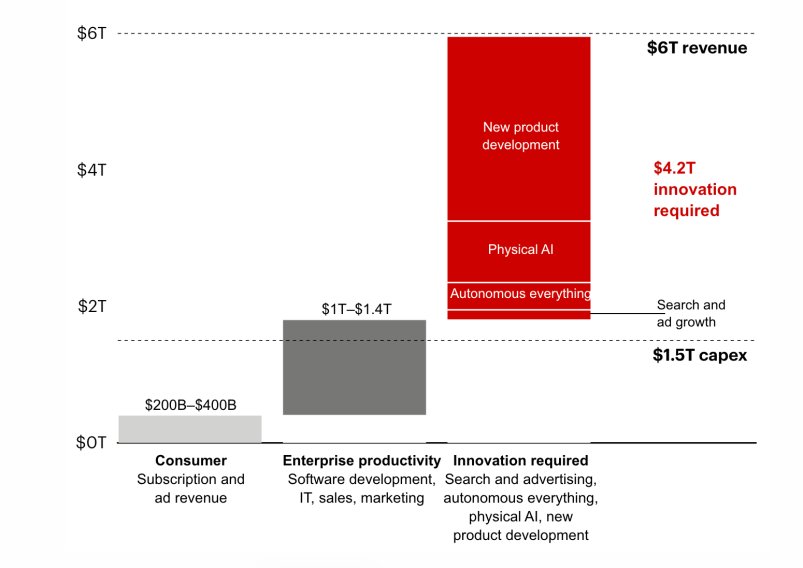
New Innovation Is Required to Fund AI’s $6 Trillion Buildout
Source: Bain
Sign up for our reads-only mailing list here.