There’s an old adage that a dart-throwing monkey could beat most professional investors.
But that’s just not true because of the way the stock market usually works. There are far more losers than winners when it comes to individual companies so the monkey would have a hard time unless they got lucky.
Through the close of the market on Thursday, the S&P 500 was up more than 13% on the year.
But the experience of individual stocks under the surface is all over the map.
Just 35% of all S&P 500 stocks are outperforming the index. Four in 10 stocks are down on the year. One-quarter of S&P 500 companies are down 10% or worse in 2026.
That includes name brands such as Lululemon (-51%), Nike (-42%), Domino’s (-28%), Fed Ex (-26%) and Netflix (-24%).
There are also 19 stocks up 100% or more including SanDisk (+665%), Dell (+341%), Intel (+232%) and CrowdStrike (+124%).
So in a good year for the stock market there are more stocks with negative returns than stocks beating the index itself. There are some big winners but a lot of losers.
In baseball terms, that means the stock market has a relatively low batting average but a strong slugging percentage. There are a lot of home runs and a lot of strike outs.
That’s been the story of this cycle.
Adam Parker at Trivariate Research has a new report out called Buy-and-Hold Doesn’t Work.
Wait what?!
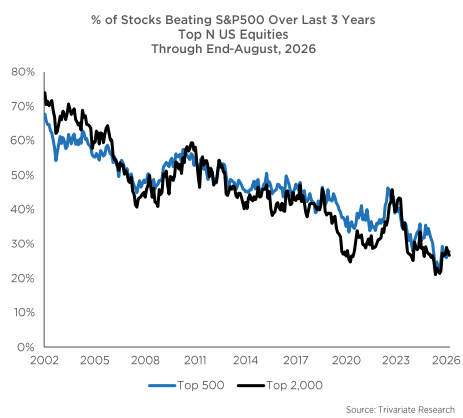
He looked at the percentage of stocks in the S&P 500 that beat the index over 1, 3 and 10 years. Here are the 3 and 10 year results:
Just 23% of stocks have beaten the S&P 500 over the past 10 years. The 3 year numbers aren’t much better. These results hold for both the top 500 and top 2,000 stocks in the market.
And the spread between the winning and losing stocks has to be about as wide as it’s ever been.
The losers over the last 3 years lost to the index by an average of 62%. Meanwhile the winners won big, outperforming by an average of more than 100%. Over 10 years the underperforming stocks lost by an average of 205% while the winners have outperformed by an average of 600%.
It’s actually been easier to outperform the market over a one year time frame than 3 or 10 years.
You could make the case that this is the hardest environment of all-time for active managers. A handful of stocks did really well. Most stocks didn’t. If you were meaningfully different from the market cap weighted index, you likely had a difficult time.
Ironically, this has likely been one of the best times to outperform as an individual investor.
Howard Marks has this theory about first and second level thinking:
First-level thinking says, “It’s a good company; let’s buy the stock.” Second-level thinking says, “It’s a good company, but everyone thinks it’s a great company, and it’s not. So the stock’s overrated and overpriced; let’s sell.”
Well, this has been a first level stock market for a while now. If it’s a good tech company that you know and use — Apple, Tesla, Google, Microsoft, Meta, etc. — it’s been a wonderful stock to own during the bull market.
You didn’t have to go to second level thinking. First level thinking has worked.
It is worth pointing out that these winning percentages have been falling rapidly this century. After the dot-com bubble burst, the win rates were much higher, in the 60-70% range.
I suppose it’s possible mega caps will rule the stock market for all of eternity but I wouldn’t bet on it. At some point the concentration will wane. Other stocks will win. There might even be more winners.
I know this market feels like an easy time to buy-and-hold individual stocks. All you had to do was buy techs stocks like Apple or Nvidia and hold on for dear life.
But those stocks are the outliers.
For quite some time now, simply picking individual stocks to buy-and-hold has been a low probability exercise.
This market has required you to be either more active or more passive by owning an index fund.
And the beauty of owning an index fund is the winners more than make up for the losers.
Michael and I talked about how hard it is to buy-and-hold individual stocks and much more on this week’s Animal Spirits video:
Subscribe to The Compound so you never miss an episode.
Further Reading:
Investing in Momentum
Now here’s what I’ve been reading lately:
Books: