My end-of-week morning train WFH reads:
• You Have No Idea What a Trillion Dollars Is — and We Have Proof: WSJ runs an interactive on what a trillion actually means as Musk closes in on it. Useful corrective for headline numbness. (Wall Street Journal)
• People love working from home. But does it love them back? A new study says no: Remote work has soared in popularity since the COVID-19 pandemic. But, a new study suggests the practice has made workers more socially isolated, anxious and depressed compared to people who work in-person in offices and other settings. NPR summarizes new evidence that remote work is producing measurable isolation costs. Worth a read whether or not you’d ever give up the home office. (NPR) see also The Record Divide Between Corporate Profits and Worker Pay: Labor’s share of economic output just hit an all-time low, while the profit share hit a near record. It helps explain why consumers feel so glum. WSJ with the chart: corporate margins at a multi-decade high, labor’s share at a multi-decade low. The kind of spread that does not stay this wide indefinitely. (Wall Street Journal)
• Wall Street Is Adding More Finance Jobs To NYC Than Anywhere Else: And NYC tech is a bigger (but not as high wage as Wall Street) employer. Jonathan Miller on the surprising return-to-NYC pattern in finance hiring. The Miami narrative is real, but the gravitational pull of Manhattan never actually went away. (Housing Notes)
• How a virtual space battle lost gamers £400,000: Every item in the game – from ships and space stations to weaponry – is manufactured by players, who can sell them to one another for in-game currency. Building these assets can take hundreds of hours, but players can also spend real money to acquire them, generating revenue for Icelandic developers Fenris Creations. For example, a Titan-class ship is worth about £741. James Cunningham estimates he has spent about £6,000 on the game since he started playing in 2017. A high-earning friend, he says, claims to have spent closer to £30,000. While spending money on video games is not uncommon, EVE Online stands out because players’ assets can be permanently destroyed; their real-world cash outlay gone in seconds. (BBC)
• How Britain Became as Poor as Mississippi: A case study in self-sabotage: The Atlantic on the UK’s two-decade productivity collapse and what’s filling the political vacuum. A useful warning shot for anyone confident in American exceptionalism. (The Atlantic)
• The Congresswoman Who Got Trump’s Name Off the Kennedy Center: Representative Joyce Beatty sued over the president’s control of the arts complex. The effort to keep it open isn’t over. On Joyce Beatty’s quiet legislative win to strip Trump’s name from the Kennedy Center renovation. Small process fights, real cumulative effect. (The Atlantic)
• How a mysterious particle could explain the universe’s missing antimatter: The Big Bang should have produced equal amounts of matter and antimatter, which would have annihilated each other in a spectacular burst of pure energy. But it didn’t. New experiments focused on understanding the enigmatic neutrino may offer insights. (Knowable)
• Football Clubs Try Training a Body Part They’ve Ignored: The Brain: Bloomberg on the European clubs investing in cognitive training the way they used to invest in physios. Decision-making is the last frontier of soccer performance. As the World Cup begins, more coaches say “game intelligence” can be taught. (Businessweek)
• These Best Friends Turned Their Chemistry Into a Comedy Empire: WSJ profile of Bowen Yang and Matt Rogers and the Las Culturistas business. The audience has the wallet now. They have parlayed their podcast ‘Las Culturistas’ into a glossy brand with a glamorous awards show and a book on the way. (Wall Street Journal)
• The Right Hand of God Game: The Knicks needed a miracle. What they got was the greatest comeback in NBA Finals history. The Ringer on Game 4 of the Finals — OG Anunoby and a Knicks comeback that’s going to live in New York forever. The kind of game the city earns once a decade. The single greatest New York Knicks moment of the 21st century requires a name. Something pithy. Evocative. Iconic. Probably with every word capitalized. It can’t be The Shot (already taken), or any variation thereof. It can’t be The Tip-In (too hyphenated), or The Tap (too dull). What unfolded late Wednesday night at Madison Square Garden, with the Knicks’ title hopes teetering and 20,000 Gothamites gasping, requires more grandeur. (The Ringer)
Video of the day: How Clarkson’s £45M Farm OUTSMARTED The Entire Industry – They Never Saw It Coming!
Be sure to check out our Masters in Business interview this weekend with Jean Eric Salata, Chair of EQT Group and Chair of EQT Asia. EQT is a purpose-driven global investment organization with over $310 billion in total assets under management, making it the largest private markets firm headquartered outside the United States.
Banks are laying the groundwork for AI-driven workforce cuts, with executives warning that automation will eliminate some roles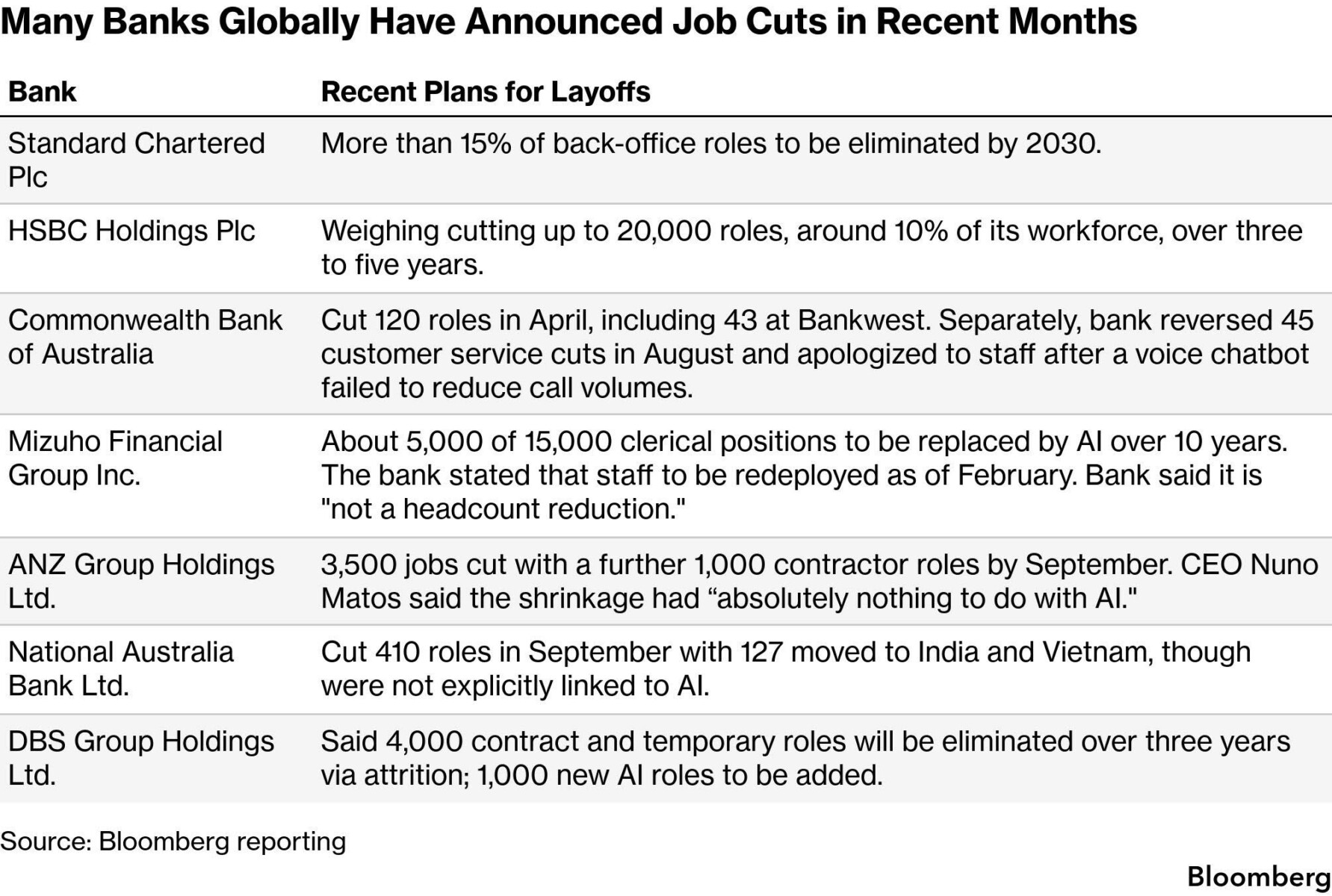
Source: Bloomberg
Sign up for our reads-only mailing list here.