A reader asks:
My question is about the potential troubles coming. Let’s say the market goes down 20% or even 30%. Would I be happy? No. But, investing for more than 12 years already (mostly DCA) – I am thinking about this kind of decline as a “time travel” back two or three years back. Wouldn’t this be a good thing?
Has there ever been a bad time-travel movie?
I say no.
Biff Tannen would have probably gotten a lot richer in Back to the Future II if he had grabbed a stock market almanac instead of the Sports Almanac.
Ah well. He didn’t look like a stock guy.
I love relating the concept of time traveling to the stock market.
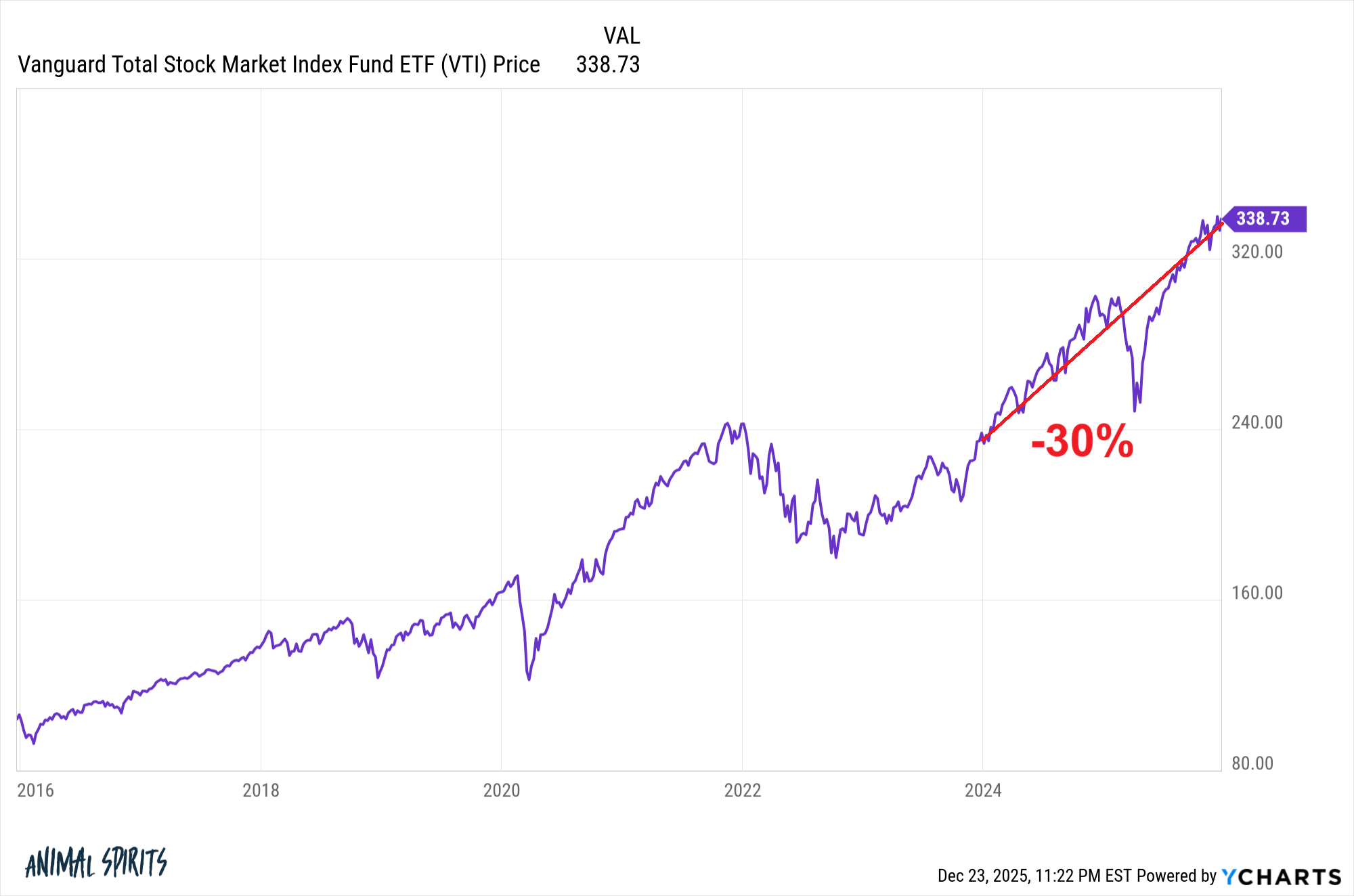
Let’s look at the chart:

If the U.S. stock market were to fall 30% from current levels, it would take us back to where it was in January of 2024.
Things weren’t so bad in January 2024, right? I’ll bet you would like to go back and buy more stocks then knowing what we know now.
The problem is that a 30% crash would make it feel like a 40% downturn is the next stop. A 40% drubbing would take the market back to May 2023.
Once stocks fall 40% a 50% crash would feel inevitable. That would wipe out nearly all of the gains this decade, taking the stock market back to September 2020 levels.
Losses of 30-50% in magnitude would not feel great. Something would have to go very wrong for that to happen.
If you kept dollar cost averaging into stocks during a crash it would be painful in the short-term but likely make you very happy in the long-term.
Of course, the stock market doesn’t crash in a vacuum. It typically happens because of a financial crisis or recession that increases the unemployment rate.
I still recall a conversation with friends during the Great Financial Crisis. It was 2008 and we had no idea how long the crisis would last.
One friend pointed out that those of us who kept our jobs would be fine.1 We could keep funneling money into our 401ks at lower and lower prices. As long as we had patience things would work out. But those who lost their jobs or homes would be set back for years.
It’s the old saying that a recession is when your neighbor loses their job. A depression when you lose yours.
And my friend was right.
The labor market was slow for many years coming out of the 2008 crisis. But anyone who kept their job, kept paying their mortgage and kept making 401k contributions made out like bandits.
It just took a few years.
Investing during a market crash depends on your intestinal fortitude but also your circumstances.
Time traveling 30-40% to the past wouldn’t be the worst thing in the world for net savers with a long time horizon…as long as you don’t experience a personal depression because of it.
We covered this question on the last new Ask the Compound of 2025:
Other questions we discussed were about buying bitcoin directly vs. the ETF (with help from Eric Balchunas), crypto vs. tech stocks, gas prices vs. recessions, and how to turn your investments into an investment plan.
1This was a few years after we graduated from college and had all just gotten married. None of us had families yet and we were just starting to buy our first houses.
This content, which contains security-related opinions and/or information, is provided for informational purposes only and should not be relied upon in any manner as professional advice, or an endorsement of any practices, products or services. There can be no guarantees or assurances that the views expressed here will be applicable for any particular facts or circumstances, and should not be relied upon in any manner. You should consult your own advisers as to legal, business, tax, and other related matters concerning any investment.
The commentary in this “post” (including any related blog, podcasts, videos, and social media) reflects the personal opinions, viewpoints, and analyses of the Ritholtz Wealth Management employees providing such comments, and should not be regarded the views of Ritholtz Wealth Management LLC. or its respective affiliates or as a description of advisory services provided by Ritholtz Wealth Management or performance returns of any Ritholtz Wealth Management Investments client.
References to any securities or digital assets, or performance data, are for illustrative purposes only and do not constitute an investment recommendation or offer to provide investment advisory services. Charts and graphs provided within are for informational purposes solely and should not be relied upon when making any investment decision. Past performance is not indicative of future results. The content speaks only as of the date indicated. Any projections, estimates, forecasts, targets, prospects, and/or opinions expressed in these materials are subject to change without notice and may differ or be contrary to opinions expressed by others.
The Compound Media, Inc., an affiliate of Ritholtz Wealth Management, receives payment from various entities for advertisements in affiliated podcasts, blogs and emails. Inclusion of such advertisements does not constitute or imply endorsement, sponsorship or recommendation thereof, or any affiliation therewith, by the Content Creator or by Ritholtz Wealth Management or any of its employees. Investments in securities involve the risk of loss. For additional advertisement disclaimers see here: https://www.ritholtzwealth.com/advertising-disclaimers
Please see disclosures here.