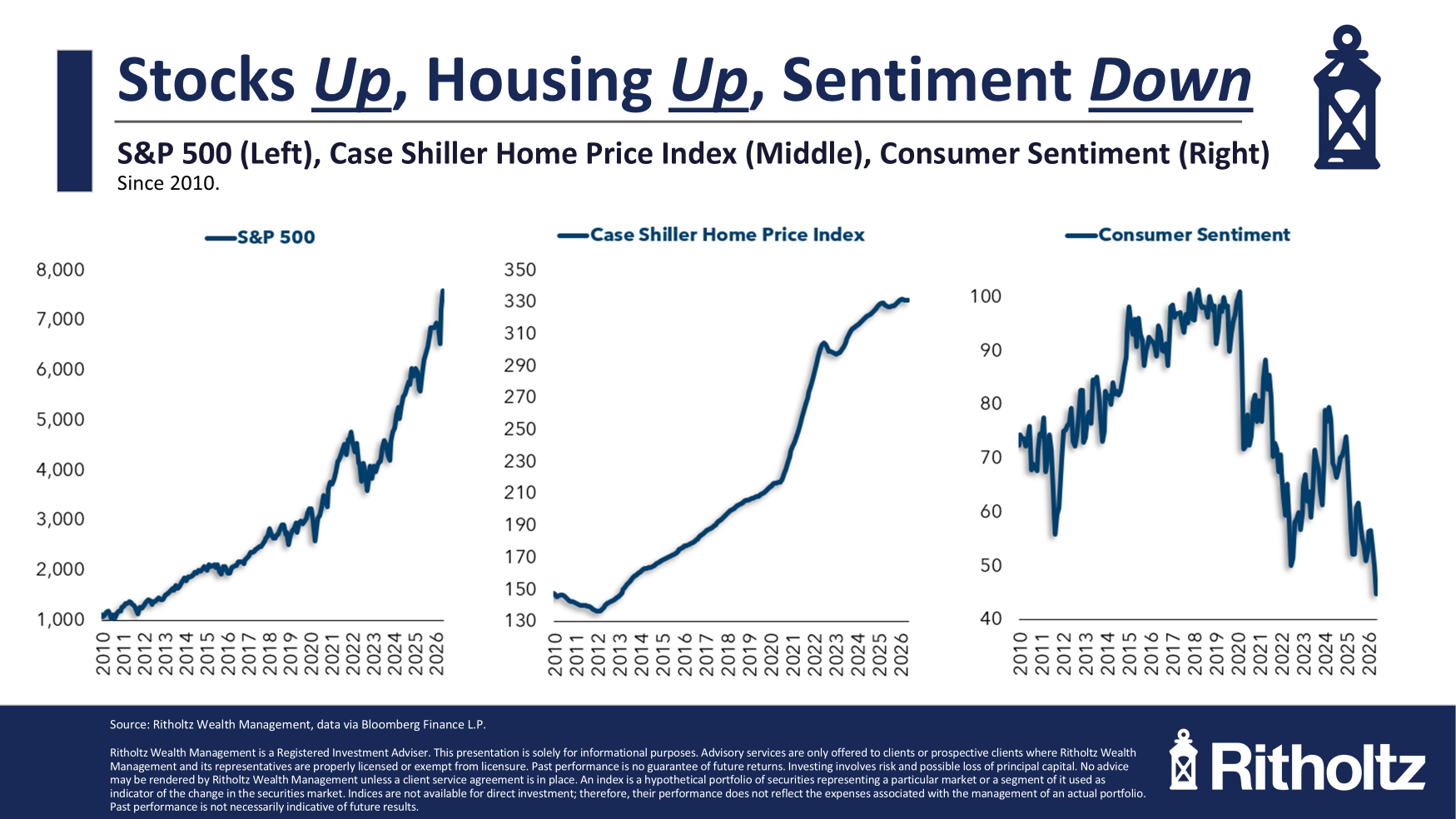
Here’s a chart for you:
Consumer sentiment readings go all the way back to the early-1950s.
The latest reading was the lowest on record.
Yes you read that right. We are currently sitting at the lowest level of consumer sentiment in the past 75 years!
Seriously people?!
Lower than the Great Financial Crisis when the stock market crashed almost 60%, the financial system nearly imploded and the unemployment rate reached more than 10%.
Lower than the aftermath of the dot-com bubble bursting which included a 50% stock market crash, a recession and 9/11.
Lower than the early-1980s which saw inflation reach double-digits, mortgage rates hit almost 20% and two recessions in the span of 3 years.
Lower than the 1970s when the stock market got cut in half, inflation ran rampant and the economy was stuck in quicksand.
Lower than the freaking Covid pandemic!
We haven’t had a real recession in 17 years. The stock market seems to hit new all-time highs every other day or so. The homeownership rate is 65%. Two-thirds of American households own stocks. The unemployment rate is 4.3%.
Americans have never been richer than they are today. It’s true:

Both the housing and stock markets have boomed this decade. Yet sentiment readings have crashed.
Is everything perfect? Of course not. It never is. But come on.
So why is this happening?
Some theories:
Inflation. People really hate paying higher prices. But inflation was way higher in the 1970s and early 1980s. And the unemployment was way higher too. Maybe the shock of higher prices is so large because it’s been four decades since we’ve experienced anything like this?
Housing costs. This is a big one, especially for young people. Housing affordability is at crisis levels. But again, most people in this country already own a house. We are sitting on a record amount of home equity at the moment.
AI worries. Technological innovations usually lead to exciting times. There is some excitement around artificial intelligence but most people hate it or don’t want it:

The fact that all of the AI founders are saying this technology is going to steal all of our jobs probably isn’t helping.
Wealth inequality. Sure, financial asset prices are higher but those assets are concentrated in the hands of the ultra wealthy.
The top 10% controls nearly 70% of the total wealth in the United States, including 87% of the stocks. The top 1% holds a staggering 32% of the wealth and close to 50% of the stocks.
The bottom 50% have seen a massive surge in wealth this decade but still control just 2.5% of the total net worth in America.
The pandemic. Look at the drop off in consumer sentiment on that chart in 2020. It was a bigger cliff than 2008. Something about the pandemic seems to have altered our collective mental state as a country.
Politics. Every single topic feels like it now boils down to us vs. them. You have to take a side based exclusively on your politics. Just look at how sentiment changes based on who is in office:

It’s exhausting.
Someone asked Nvidia’s Jensen Huang if he would rather relive his 20s back in the day or be 20 years old today:
I thought our 20s were happier than these 20s. I think everyone deserves some time to be oblivious, and not wear all of the world’s problems on their shoulders on Day 1. We are raising a generation that is very cynical and too informed. They are cynical, not because they are inherently cynical. They are cynical because they see so much stuff. It is too much stuff.
It was so much easier to be oblivious and naive about the world at large when I was growing up in the 1990s and early-2000s. No one ever talked about politics. You weren’t force-fed the news or ugly headlines and opinions via social media.
We didn’t have cell phone cameras or the angst you get from being on social media.
I wholeheartedly agree that it’s much more difficult to be a young person today.
Surveys are broken. I’ve written about this before. Who even answers these surveys anymore? How are the questions being asked? You have to watch what people do not what they say.
I’m fine. There’s also a tendency for people to say the world at large is going to hell but I’m doing great thank you very much.
Just look at the results from the Fed’s report of economic well-being:

The percentage of people who say their own finances are doing okay or living comfortably is still very high. This is obvious when you interact with people in the real world.
Feelings about the local and national economy are much worse.
Why is this the case?
The constant drumbeat of negativity. Our brains are not evolved enough to handle the deluge of negativity being thrown at us every single day.
The history of humanity is progress interspersed with very bad things happening. More bad things aren’t happening today than in the past. It’s just that now you’re forced to learn about them all the time because we now have the sum of human knowledge and activities in our pockets.
The information age can turn you into a cynical person without ever realizing you’ve been radicalized.
Maybe we’ll get used to it eventually. For now, sentiment readings are just off and likely will be for some time.
In the meantime, turn off the cable news for a while. Log off social media for a few days. Avoid politics like the plague.
Go outside.
Your personal consumer sentiment will improve immediately.
Michael and I talked about consumer sentiment and much more on this week’s Animal Spirits video:
Subscribe to The Compound so you never miss an episode.
Further Reading:
The Longest Economic Boom Ever?
Now here’s what I’ve been reading lately:
Books:
Podcast book tour: