I’ve written a number of pieces over the years about how hedge fund managers are seemingly always bearish.
Ray Dalio has been predicting a financial crisis for years now:
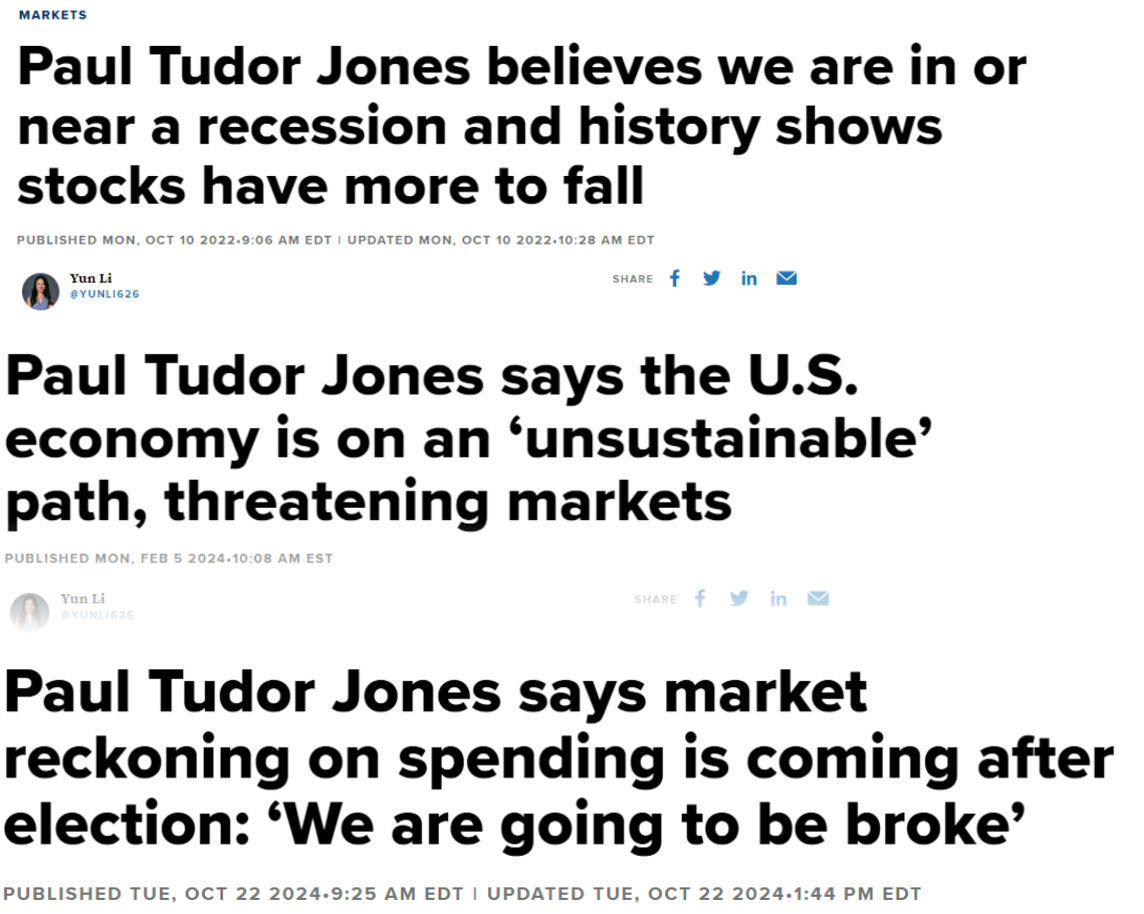
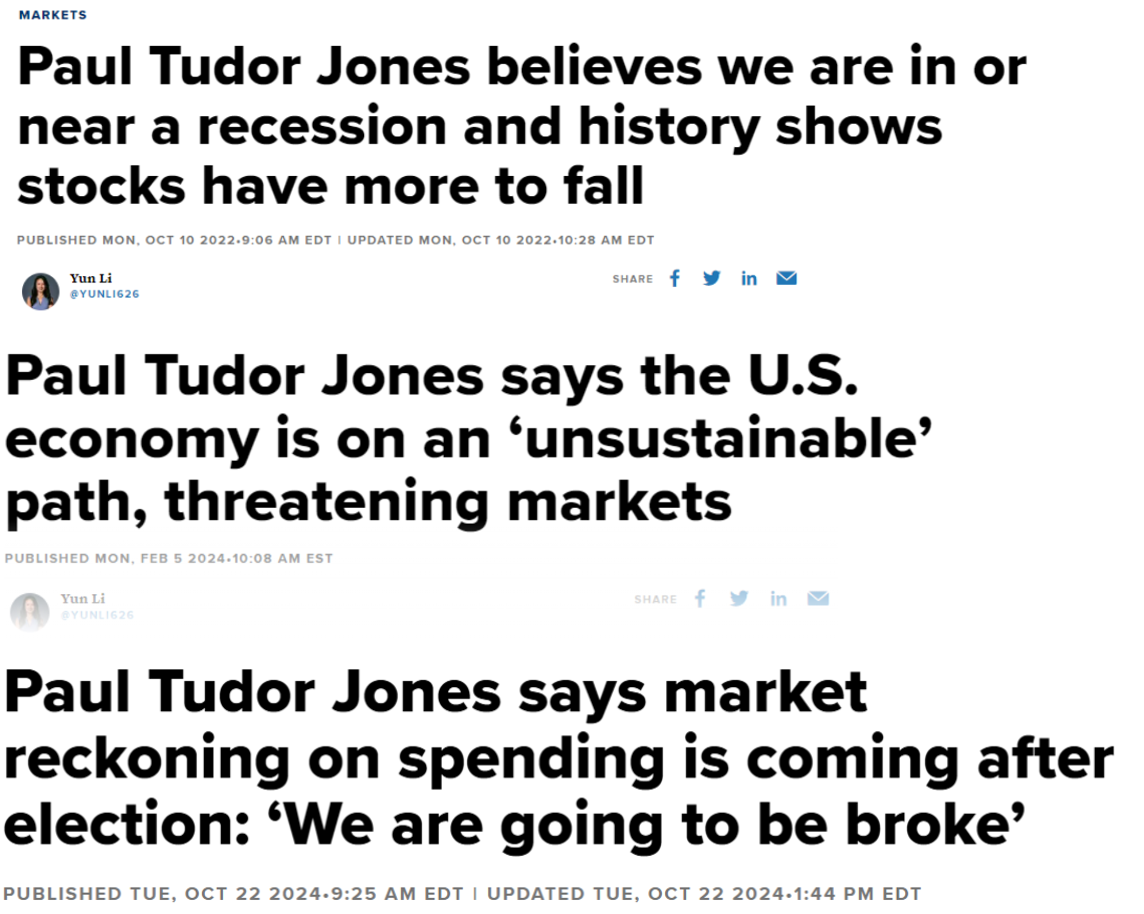
Paul Tudor Jones has been predicting a comeuppance for a while too:
I think it’s beneficial to know that even legendary investors have a hard time forecasting what comes next. If the legends can’t do it what chance do we mere mortals have?
Tudor Jones was on Invest Like the Best with Patrick O’Shaughnessy and it was instructive to understand the mindset of a hedge fund manager when it comes to these forecasts.
He’s still worried about the state of the markets. Here are some select quotes from the interview:
In the stock market, we’re over-equitized as a country. We have the highest individual equity weightings in the history of the country.
We’re 252% of stock market cap to GDP. In 1929 we were 65%. In 1987 we got to ~85-90%. In 2000, 170%.
The problem is that if you buy the S&P at this current valuation, the 10-year forward return is negative when you buy the S&P with a PE of 22. That’s what history shows.
Valuation matters a lot, and the stock market’s really high and it’s gonna be really hard to make money from here with any kind of long-term view.
I have thoughts about stock market cap to GDP but I’ll save them for another time. The important thing to note about predictions like this is that Paul Tudor Jones is a trader, not a long-term investor.
What was fascinating to me about this interview was not his market views but rather how he described his investment personality:
I used to sit there and rail on Warren Buffett year after year. I’d say he just happened to be in the right place at the right time and caught this bull market. Our fund has a minus 0.12 correlation with the S&P 500 over 40 years. So 100% of our returns are alpha. That’s the difference between investing and trading. I was just thinking, why couldn’t I be Warren Buffett? Just believe in America, and when you’re down 50%, who cares, because America’s gonna bring you through. I feel like I’ve been a right guard in the NFL for 50 years, fighting in the trenches every day.
Now the bearishness makes sense! It’s his natural disposition.
This guy was hard wired to be a trader. He’s not a Warren Buffett, buy and hold investor. Each discipline requires a different mindset.
This is why hedge fund managers are constantly making dire predictions about the market.
Tudor Jones said he predicted a depression following the 1987 crash. Ray Dalio predicted a depression in 1982 right before one of the greatest bull markets of all-time. Stanley Druckenmiller has been making bearish calls this entire bull market too.
Guess what?
All of these guys still made a ton of money following those predictions because they weren’t investing their funds based on these forecasts. To be a hedge fund manager, you almost have to be bearish by nature.
It’s a personality thing.
Any time a bond fund manager goes on CNBC they are bearish about the stock market. Why do you think they are bond managers in the first place?
This is instructive for investors of all shapes and sizes, not just legendary traders and hedge fund managers.
You have to understand your internal make-up to ensure it matches up with your investment philosophy.
I understood the Buffett/Bogle idea of buy-and-hold for the long-term immediately. It fits my personality type.
I don’t have the emotional disposition to be a trader and change my mind all the time. It would make me a wreck just like it would make Paul Tudor Jones uncomfortable to invest for the long run like Warren Buffett.
Investment truths are rarely black or white but rather shades of gray.
The perfect investment strategy is the one you get stick with come hell or high water.
Some people are meant to hedge. Some are meant to buy and hold. Some need a mixture of both.
The first step is figuring out what your philosophy is and ensuring it mixes well with your emotional disposition.
Michael and I talked about Paul Tudor Jones, market cap-to-GDP and much more on this week’s Animal Spirits video:
Subscribe to The Compound so you never miss an episode.
Further Reading:
Don’t Take Financial Advice From Hedge Fund Managers
Now here’s what I’ve been reading lately:
Books: